Lab Grown Diamond Price in India: The Factory's Numbers
By SGJ · · 12 min read
Start with what sets the number, because every headline figure you will find elsewhere is someone else’s markup quoted back at you. The lab grown diamond price in India comes off four dials — carat, colour, clarity and cut — then the metal around the stone and the making. We quote from our own Mumbai bench on the spec you pick, every piece with IGI, GIA or HRD paper, and the same spec mined would cost up to 60% more.
Those are the only figures on this page, because they are the only ones we can stand behind. Everything else you will find online is a different seller's route to you, priced in. This guide explains the route, and how to pay for the stone instead of it.
What does the lab grown diamond price in India actually cover?
Follow one stone's invoice and the price explains itself. It leaves a growing facility as rough. A cutting workshop shapes and sets it — that is us. From there, most stones pass to a distributor, then to a showroom, and each stop adds its own line to what you eventually pay: logistics, inventory risk, counter rent, commissions.
None of those lines make the stone better. They are the cost of the route.
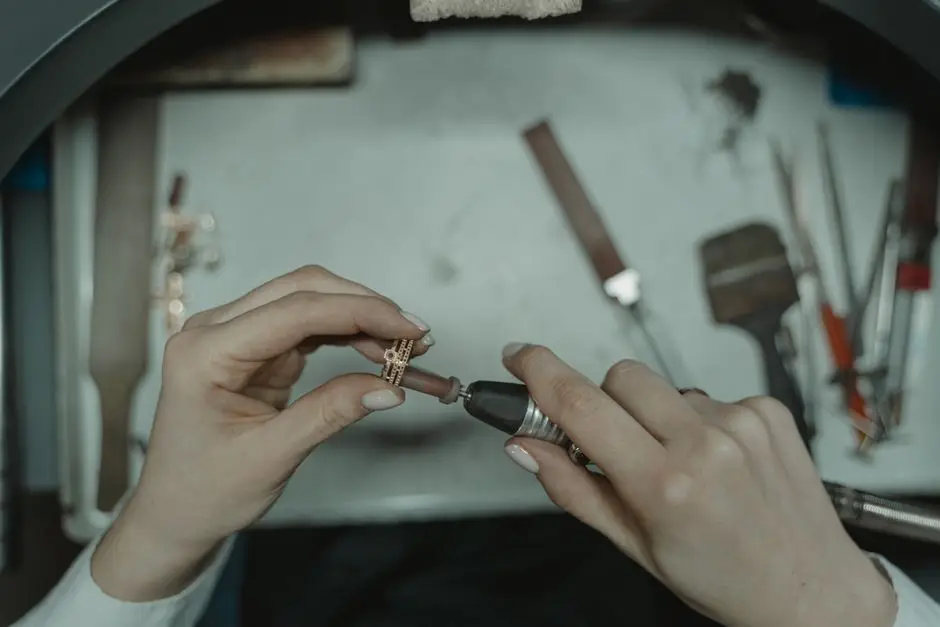
We cut and set our own stones in the Mumbai workshop. We sell them direct. Fewer hands between the bench and you is the whole story behind the starting prices above — no discount mathematics involved.
Are lab grown diamonds cheaper, and why?
Yes — and the reason is production, not quality.
A mined stone pays for exploration, extraction, and a supply chain built to move a few grams across three continents. A lab grown stone is produced on a schedule in a controlled facility — grown either by CVD, which deposits carbon layer by layer, or by HPHT, which recreates mining-depth pressure — the section below covers what each does to the stone you are offered. Growing to order costs less than searching the ground, which is why the cvd diamond price in India sits well below mined for the same finished spec.
So the lab grown vs natural diamond price gap is a production-cost gap. Chemically and optically it is the same stone a mine produces — a gemmologist needs instruments, not eyes, to tell the origin. The price difference keeps being read as a quality difference, and it simply is not one.
What actually changes the price?
Four properties move any diamond's bill, and the GIA's 4Cs guide defines all four.
Carat moves it hardest. Growing one large, clean crystal takes longer than growing several small ones, and fewer large crystals come out flawless — so a single big stone always outprices the same weight split across smaller ones. Two one-carat stones with different cut and clarity grades are genuinely different products. A quote that ignores the grades is quoting weight, not a diamond.
Cut decides whether the stone looks alive. It is the property people underweight when comparing on paper, because it is the hardest to judge from a listing.
Colour and clarity grade what magnification can find. On the hand or the ear, cut does more for the look than a clarity step nobody can see without a loupe — worth remembering when a budget is stretched over a grade.
Does the certificate change what you pay?
Yes, slightly — grading is real work by a real lab, and its fee travels with the stone. It is the best money in the whole quote.
Nothing leaves our bench without IGI, GIA or HRD paper. On a loose lab grown stone that now means IGI in practice — GIA replaced its four-Cs lab grown grading with a one-word assessment in October 2025, and HRD left loose lab grown certification in 2026. An IGI report still states carat, cut, colour and clarity, and the number on it can be looked up in IGI's own database — we wrote a step-by-step guide to checking a report, and it works on any seller's stone, not just ours. When two similar-looking quotes disagree, the reports usually contain the entire explanation.
What does a custom piece cost?
It starts from the same rings-line floor, with the stone, gold weight and making deciding the rest. Describe the piece, we design it with you, and it is typically finished in about two weeks. Nobody between us means custom work carries no coordination premium.
The lab grown diamond rings page shows how this plays out on the category we make most; for pairs, the diamond earrings price guide walks the same arithmetic ear by ear. The lab grown diamond cost logic is identical everywhere: stone, setting, labour, route.
How the two growth methods differ, and what it changes
Every lab grown stone in a quote came out of one of two kinds of machine, and growers argue for whichever chamber they own. We do not own one. Stones arrive at our Mumbai bench grown both ways, we cut and set them, and we are paid the same either way — so here is the version with nothing riding on it.
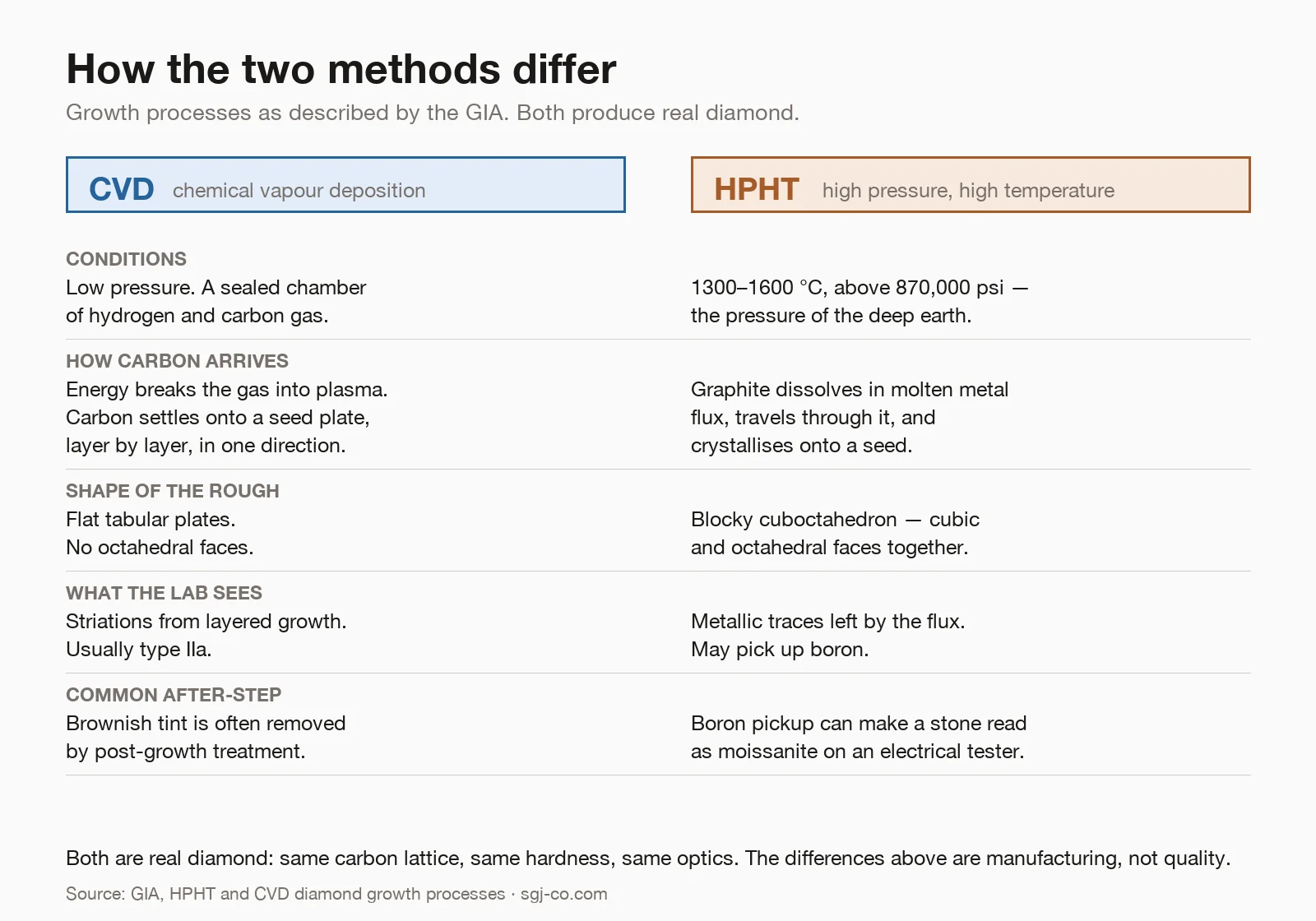
CVD — chemical vapour deposition — is a manufacturing process, not a grade. A thin slice of diamond, the seed, goes into a sealed chamber at low pressure holding hydrogen and a carbon-carrying gas, usually methane. Energy, typically a microwave beam, breaks that gas into plasma. Carbon released from the plasma settles onto the seed and locks into its lattice, building upward one layer at a time in a single direction. Weeks of that produces rough big enough to cut.
HPHT does the opposite. A press takes the capsule to 1,300–1,600 °C and above 870,000 pounds per square inch. Inside, graphite dissolves into a molten metal flux — iron, nickel, cobalt — which lowers the conditions needed. Carbon travels through that bath and crystallises onto a cooler seed. Nothing is squeezed into anything; the metal bath does the work, and it is where HPHT's characteristic inclusions come from. GIA's account of both growth processes is the source for those numbers.
What tabular rough means for the shape you are offered
This is bench knowledge rather than laboratory knowledge, and it is the part that actually changes what you see in a tray.
A cutter works with the block they are given. CVD rough is a flat plate, so it yields best to shapes that are themselves shallow and spread — the elongated fancies, ovals and emeralds and radiants, which want length and width more than depth. HPHT's blocky cuboctahedron suits a round brilliant better, because a round wants depth to work with.
Nobody is prevented from cutting anything. A round can be cut from a CVD plate and often is. But cutting against the rough's natural form means throwing more of it away, and wasted weight is priced into what survives. That yield arithmetic is why availability and price by shape can differ between the two methods, and why the fancy shapes have been the friendlier end of the CVD market.
The practical version: if your heart is set on a specific shape, ask what is actually available in it rather than assuming every shape carries a fixed step up or down.
Are CVD diamonds real diamonds?
Yes. Carbon in the diamond lattice, hardest material on the scale, identical optics. A gemmologist needs laboratory instruments to establish origin — an eye and a loupe have nothing to work with.
What those instruments read are growth fingerprints, not flaws. CVD crystals carry striations from their layered build. HPHT crystals carry metallic traces from the flux bath. Most mined stones carry nitrogen that geological time has clumped into aggregated patterns no reactor can reproduce in weeks; a minority of mined stones contain no detectable nitrogen at all, and those are the ones that send a laboratory to its bigger instruments.
Different histories. Same substance.
The post-growth treatment nobody mentions
One thing here is worth more than the rest of this section.
As-grown CVD material commonly comes out with a brownish cast, and that cast is often removed afterwards — frequently using heat and pressure, which is to say the other method's technology. The treatment is permanent and does not make the stone worse. It is simply a fact about the stone, and one you are entitled to see.
Where it gets awkward is the report, and this is the sentence most guides get wrong: no law requires a laboratory to disclose it. Report contents are each laboratory's own policy, and the policies differ. IGI states growth method, and describes an untreated stone as as grown with no indication of post-growth treatment. Where treatment is suspected it says the stone may include post-growth treatment — a hedge, because after the fact it often cannot be proven. GIA's October 2025 change replaced grading with a Premium or Standard classification altogether.
So "read the treatment line" is good advice with a caveat attached: check which report you are holding first, because it may not have one.
CVD or HPHT: which should you buy?
Compare the stones, not the methods. None of the above is a quality ranking.
The reasoning is short. A finished stone comes with a report describing what it is. Those grades were measured on the object in front of you. The growth method is a fact about equipment you will never see, and it does not appear anywhere in how the stone looks or wears.
So: two stones, matched grades, one CVD and one HPHT. Identical to a wearer. If one costs less, buy that one. A premium charged for a growth method is a premium charged for a preference. One caveat, stated properly rather than hinted at: that grade-by-grade comparison needs four grades on both reports, and as of 2026 only IGI still issues those for a loose lab grown stone.
Is a lab grown diamond better for the environment?
Probably, and we are not going to pretend we can prove it to you.
The honest shape of the answer: growing a diamond avoids moving the enormous volume of earth that recovering one requires, which is a genuine difference. Against that, a growth chamber runs hot for weeks and the footprint depends almost entirely on what is generating that electricity — a reactor on renewable power and one on a coal grid are not the same product, and the label on the stone will not tell you which you have.
What you will find instead is a great many confident comparison figures, most of them published by companies with an interest in the answer and very few of them independently audited. We have no audited numbers of our own, so we are not adding to the pile. If the environmental case is what is driving your purchase, ask the specific seller where their stones were grown and on what power, and treat any number without an auditor's name attached as marketing.
When we would tell you not to buy lab grown
Three cases, and we lose the occasional order to each.
When you are buying it as an asset. Lab grown resale is poor and the wholesale price of grown material has been falling for years, which is excellent news if you are buying jewellery and bad news if you are buying an investment. Buy the ring to wear it.
When somebody is selling you the method. If a quote leans on CVD or HPHT as the reason for its price rather than on the grades, walk. That is a story being sold, and you will pay for the story.
When it has to be a mined stone. If the brief is an heirloom, or a family stone, or anything where the origin carries meaning for the person receiving it, then origin is the point and no laboratory-grown stone is the right answer regardless of how it was grown.
The questions everyone asks
Is a CVD diamond a real diamond?
Yes — the same carbon lattice, hardness and optics as a mined stone, which is why laboratories grade it on the standard scales rather than treating it as a simulant. The difference is where it was made.
Is CVD better than HPHT?
Neither is better as a category, and a seller who says otherwise is describing their own equipment. Their real differences are rough shape, the fingerprints a laboratory reads, and which after-steps each commonly needs — none of which a wearer can see.
Do CVD diamonds pass a diamond tester?
Yes, because a tester reads material and CVD material is diamond. The quirk worth knowing runs the other way: HPHT stones sometimes pick up trace boron from the growth flux, boron-bearing diamond conducts electricity, and that can register as moissanite on an electrical or dual tester. A misread, not a verdict.
Do CVD diamonds fade or cloud over time?
Not permanently, and not with ordinary wear. Some CVD stones are photochromic — colour can shift slightly under strong ultraviolet light or heat and returns on its own. Diamond is also the hardest material but not the toughest: it has cleavage planes and a sharp knock in the wrong place can chip one, which is what insurance and a sensible setting are for.
What to ask before you pay
Four questions, any seller:
- Who made this? A seller who cannot name the workshop is quoting you someone else's invoice plus their own.
- What is the report number? Then look it up yourself rather than trusting the printout.
- What is the gold weight and karat? Check the piece is BIS hallmarked — India's legal purity standard — and ask which day's gold rate the quote uses.
- What does this spec cost from one other seller? A single second quote is the cheapest research you will ever do.
And one case where we will point you away from our own product: if the brief is really a family stone — resetting an heirloom, keeping a mined diamond's story alive — sentiment outranks arithmetic, and a lab grown replacement is the wrong answer. We would rather say that here than at the counter.
Message us on WhatsApp with the spec you are considering and the quote comes back itemised against the certificate — start from the homepage and the WhatsApp button opens the chat. Bharat Diamond Bourse member, GJEPC member, shipped anywhere in India, Mumbai visits by appointment. The other guides are on the guides index.